
How Manufacturers Can Use AI to Drive Operational Results


Most manufacturers we talk to aren't behind because they haven't adopted AI. They're behind because they haven't yet asked the right question, not "should we use AI?" but "what problem are we actually trying to solve and is our data in good enough shape to let AI solve it?"
How to Identify the Right AI Use Cases for Your Manufacturing Operation
The manufacturers who get the most out of AI aren't the ones who rushed to implement it. They're the ones who got clear on their pain points first. Whether it's a five-day close process that's eating up time, inventory levels that are hard to predict, or a sales and operations planning cycle that feels more reactive than strategic, these are the kinds of problems where AI can deliver real, measurable value.
Some of the most common starting points we see include:
Business intelligence frameworks
Business intelligence frameworks pull data from ERP, CRM, and operational systems into a centralized platform with tools like Power BI. Without this, leadership is making decisions based on stale reports and disconnected spreadsheets. With it, you get faster closes, cleaner visibility, and a single source of truth that the whole organization can trust.
AP/AR automation
AP/AR automation reduces manual processing time and improves cash flow management. When invoice processing is still handled manually, errors compound, cycles slow, and your team spends time on work that adds no strategic value. Automating these workflows frees your people for higher-value work and tightens your cash position at the same time.
Sales and operations planning
Sales and operations planning touches forecast and demand management, inventory planning, cash forecasting, and capacity modeling, helping manufacturers get ahead of demand rather than constantly catching up to it. When these functions are disconnected, the cost shows up as excess inventory, missed shipments, unplanned overtime, and a planning cycle that's always one step behind. Connecting them with AI changes the equation.
Production scheduling
Production scheduling is one of the highest ROI opportunities for AI in manufacturing and one of the most overlooked. Most manufacturers we work with are still doing this on spreadsheets or whiteboards. When scheduling is reactive and manual, it shows up as overtime, missed commitments, and capacity you didn't know you had. AI-assisted scheduling changes that equation quickly, and the results are measurable fast.
The goal isn't to automate everything at once. It's to identify a near-term, high-impact target and prove the value before scaling.
Don't Let These Misconceptions Slow You Down
A few things we hear that aren't true:
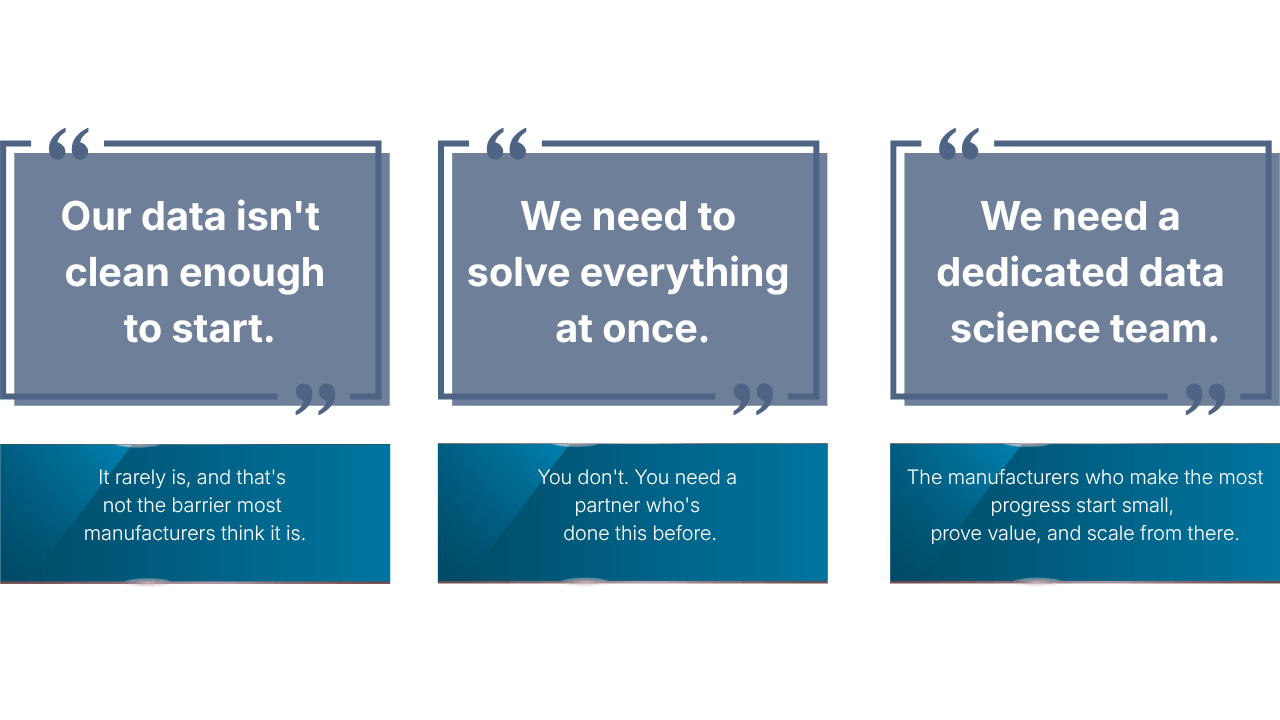
Why Data Discipline is the Key to Successful AI Implementation in Manufacturing
Before any AI tool can deliver results, the data feeding it must be trustworthy. This is where a lot of manufacturers get tripped up. It's not enough to have data. It needs to be accurate, consistently formatted, and accessible across systems.
Think of data discipline as the groundwork that makes everything else possible. Manufacturers who build this foundation first are the ones who can move quickly and confidently when it's time to implement. Those who skip it often find that AI doesn't solve their problems, it just makes them more visible.
This also means having clarity around who owns the data, who has access to it, and how it's being maintained. These aren't glamorous conversations, but they're the ones that determine whether your AI investment pays off. What we typically see when we walk into a manufacturer's operation is data that exists but isn't trusted; finance has their numbers, ops has theirs, and nobody's working from the same source of truth.
Change Management: The Missing Piece in Manufacturing AI Adoption
Here's something that doesn't get talked about enough: in a world where AI is rapidly commoditizing expertise, experience is the differentiator. The manufacturers who win aren't necessarily the ones with the most sophisticated technology. They're the ones who can effectively lead their people through change.
AI moves at the speed of electrons. Human systems move at the speed of trust. That means change management, communication, and the ability to bring your team along on the journey are just as important as the technology itself. Leaders who treat AI as an IT initiative rather than an organizational one tend to struggle. Those who build buy-in from the shop floor up tend to see results.
How Manufacturers Can Get Started with AI Today
If you're a manufacturer trying to figure out where to start, here's a straightforward way to think about it:
First, identify your most pressing operational challenge, something with a clear cost or inefficiency attached to it. Second, assess whether your data is in good enough shape to support a solution. Third, start small with a pilot that has defined goals and measurable outcomes. Build from there.
You don't need a dedicated data science team or a massive technology budget to make progress. What you need is the right partner who understands your industry, knows where the real opportunities are, and can help you avoid the common mistakes like automating the wrong things or chasing technology for technology's sake.
The manufacturers who will look back five years from now and feel good about where they are won't necessarily be the ones who moved first. They'll be the ones who moved smart.
Ready to explore what AI could look like for your organization?
What you need is clarity about where to start and a partner who's done it before. Let's spend 30 minutes mapping exactly that. Contact us to start the conversation.
Expert Contributors
Glenn Plunkett
Director